


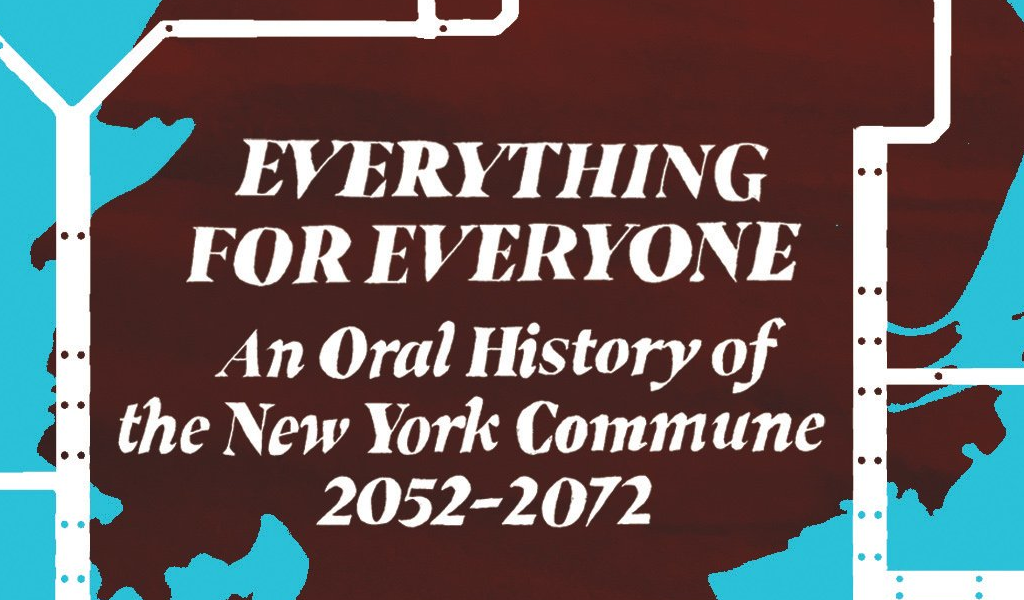
Too many writings and stories about the future envision a future where everything goes to hell. It is much more difficult to offer a positive vision, regardless whether or not that vision is plausible or even desirable. That is why I read with interest one novel which proposes a positive post-capitalist future: “Everything for Everyone: An Oral History of the New York Commune, 2052-2072″ by M.E. O’Brien and Eman Adbelhadi (Common Notions Press, 2022).
The book begins with an introductory section which describes in sixteen dense and whirlwind pages a brave new world and how it arose during the twenty-first century. “By the middle of the twenty-first century, war, famine, economic collapse, and climate catastrophe had toppled the world’s governments.” So, yes, “Everything for Everyone” also envisions a future where everything goes to hell, but rather that leave it at that, popular social movements instead galvanize to boldly forge the institutional replacements of the current government/corporate nexus: “the world commune, the free assemblies, the planning forums, the local residential communes as a primary reproductive unit, [and] the production councils”. This unfolds in such a way that “varied visions of revolutionary social change…proved inadequate to understand the direct, antimarket, and antistate character of the insurrection as it unfolded”.
“Everything for Everyone”, much like “World War Z” by Max Brooks or “RPS/2044” by Michael Albert, then shares a series of lengthy interviews, each in a single chapter with a single individual, which elaborates on various elements of this future world and the history that led to it. Since the book is set in and around New York City, most of the focus is local to that part of the world. But we get hints that what we see in New York City has transpired in similar dimensions globally. The variety of the interviews — in tone, in content, and in sophistication — is impressive and palpable.
“Everything for Everyone” is well-written, chock-full of intriguing ideas, and carries with it a sheer fearlessness that is quite admirable. I also admire the it-is-not-all-about-economics approach leavened throughout the book: it gives full respect to other social dimensions besides economics — race and gender relations among them. The book even correctly predicted an unprovoked U.S. war with Iran, even if it got the start date wrong by fourteen years.
Even so, I have some (slight) misgivings with “Everything for Everyone”. The book gives tantalizing details of how a future non-hierarchical society would work, but it doesn’t offer a detailed model of how the society would work, particularly on the economics front. To be fair, the book is a novel, not an instruction manual, and I admit a personal bias to looking for models since I personally have worked for most of the past decade building and testing computerized economic models. (I would not be able to build a computerized version of the economy in “Everything for Everyone” because I don’t have enough precise details.) Even so, having some precise details as to how things work in this future world would strengthen the main goal of the novel that Another World Is Possible.
As an example: There are extremely complicated collective endeavors that have been built in this future world, like a space elevator near Quito, Ecuador, and enormous oceanic algae farms which provide electricity to the Atlantic coast. How were such massive endeavors organized? How are collective-consumption decisions like this made? How are the resources necessary to build something so massive allocated? There is a hint that it follows something along the lines of the model of a participatory economy; the final interview in the book makes reference to a “network that crunches data on production and consumption, and produces reports and tools for forums and production councils to use” and to “the next cycle”.
Another misgiving I have is that the role of the media, or their replacement, is nonexistent in “Everything for Everyone”. A considerable reason why progress is blocked or slowed is because of the major media, what people know or don’t know and when, and how they learn it if they ever do. (By the way, the politics of media in America is another multi-decade activist focus of mine.) How was that overcome in the building of a new society, especially where the media play a crucial role in suppressing attempts at revolution like Occupy Wall Street? We get hints of such a media network at play in the future, involving computerized fora of various sorts, but again it would make for a stronger novel and more compelling vision if that is spelled out more.
There’s also another deep question indirectly posed by “Everything for Everyone”: Is the corporate/state/capitalist nexus so powerful and so all-reaching that it cannot be overcome until it collapses of its own accord? The novel posits that the new world doesn’t arise until the old world has been burned to ashes. Perhaps, but there’s no reason that substantial improvements cannot transpire without a collapse; in fact, in New York City itself in the past calendar year, the city audaciously elected a democratic socialist as mayor and has balanced its budget, erasing a multi-billion-dollar debt largely by taxing the rich. Perhaps we can build a better society in the here and now.
Misgivings aside, “Everything for Everyone” is an inspiring and thought-provoking novel, worthy of your time and consideration. Advocates for the model of a participatory economy, and indeed everyone who is interested in a better future world, would do well to read the book and consider its vision.
Start the discussion at forum.participatoryeconomy.org